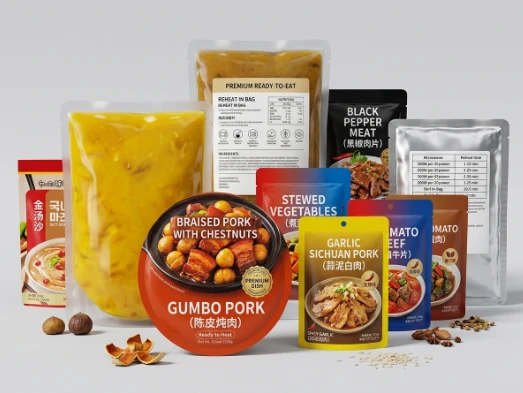
Retort pouches are used for foods that require thermal processing in a sealed package. Unlike ordinary ambient or frozen food bags, a retort pouch must withstand a defined combination of temperature, time, pressure, product chemistry, and handling while maintaining package integrity. Selecting a structure based only on a stated maximum temperature is not enough. The complete package must be qualified for the intended process and food.
Define the actual retort process
The first step is to document the scheduled process, including target temperature, holding time, pressure conditions, heating and cooling profile, and product characteristics. A pouch used for a water-based meal may face different demands from one containing oil, acidic ingredients, or particulates. Filling temperature, headspace, pouch dimensions, and loading configuration can also affect processing.
Thermal processing must be established by qualified food-processing professionals. Packaging suppliers can advise on material compatibility, but they should not replace process-authority validation or the food manufacturer's food-safety procedures.
Understand the functions of each layer
Traditional retort laminates may combine a print-support layer, an adhesive system, a barrier layer, and a heat-seal layer. Aluminium foil can provide strong barriers to light, oxygen, and moisture, while high-temperature sealant layers must maintain integrity during processing. Some structures use alternative barrier technologies, but suitability depends on the required performance and process conditions.
A structure that performs well at room temperature may behave differently during retorting. Heat can affect adhesive bonds, dimensional stability, sealant properties, and the interaction between the package and the food. Therefore, material qualification should cover the complete laminate and finished pouch, not isolated film samples only.
Watch for common failure modes
Potential problems include delamination, seal distortion, channel leaks, pinholes, pouch swelling, and damage during post-process handling. Oil or product residue in the seal area can compromise closure integrity. Sharp food particles, excessive pouch loading, or poor handling may create local stress. Failures can emerge after cooling or storage, so inspection immediately after retorting is not sufficient on its own.
The supplier and food processor should agree on test methods appropriate to the package and product. Depending on the process, verification may include seal-strength assessment, leak testing, visual inspection, package integrity testing after retort, and storage evaluation. Any accelerated study should be justified and should not be treated as an automatic substitute for real-time evidence.
Validate on the intended equipment
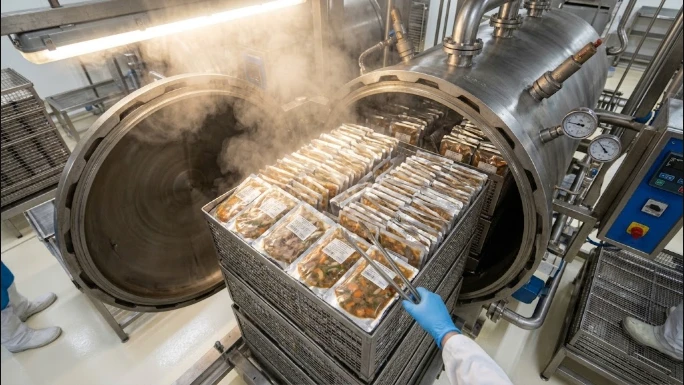
Retort performance depends on the full process, including the retort system, pouch orientation, loading pattern, pressure control, and cooling conditions. Trials should use production-representative pouches, actual product or a justified substitute, and the intended process settings. Record results and investigate failures before scaling up.
Questions to resolve before ordering
Buyers should provide the food type, formulation characteristics, target process, pouch dimensions, filling conditions, expected shelf life, and distribution environment. Ask the supplier for the proposed laminate structure, applicable technical data, food-contact documentation, and evidence of suitability for the specified retort conditions.
Retort packaging is a system, not just a heat-resistant film. Reliable performance depends on a compatible structure, validated thermal processing, sound seals, and controlled handling. Any change to the laminate, pouch dimensions, filling conditions, or retort schedule should be assessed before commercial release.